
This workshop brought together researchers and political stakeholders to examine the fabrication, dissemination, and reception of Russian malign narratives in the context of the war against Ukraine. Organised in cooperation with Clingendael – the Netherlands Institute of International Relations, the event featured expert inputs on evolving disinformation strategies, technical infrastructures, and the role of troll networks, alongside a dedicated panel in which Prof. Hanna Klimpe and Dr. Christian Noack presented findings from the NARDIV Work Package. Their research analysed how Facebook users in France, Germany, Poland, and Slovakia engaged with Russian malign narratives during the first 18 months of the war. The workshop concluded with a focused discussion on policy recommendations for countering the spread of malign information.

Talk: Russian malign information on social media
How does Russian disinformation operate on social media—and why does it spread so effectively? These questions were at the center of a joint event by ZEIT STIFTUNG BUCERIUS and NARDIV, where researchers presented new quantitative and qualitative findings on emotionally driven user engagement, digital media ecosystems, and the implications for public debate, journalism, and democratic resilience.

Workshop: Russian malign information - quantitative and qualitative approaches 2
At a NARDIV workshop hosted by NASK in Warsaw on 5 March 2026, researchers and political stakeholders discussed new findings on the spread and reception of Russian malign narratives on social media. Presentations by Wojciech Solak and Dr. Christian Noack highlighted comparative research from France, Germany, Poland, and Slovakia, showing that user engagement with disinformation is largely emotionally driven and shaped by national media environments. The workshop concluded with policy recommendations for countering malign information and strengthening media literacy.
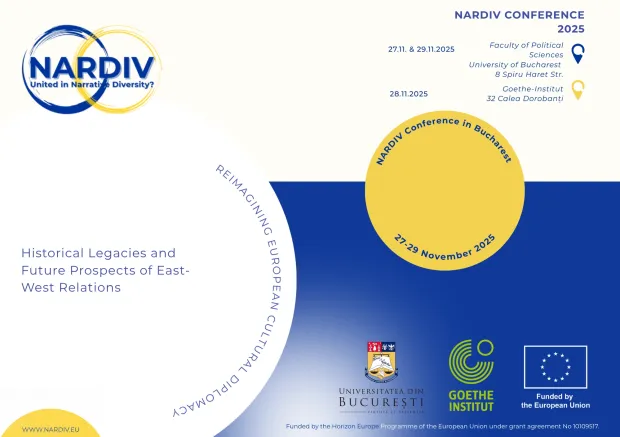
NARDIV Conference 2025: Reimagining European Cultural Diplomacy
The international conference “Reimagining European Cultural Diplomacy” took place in Bucharest from 27–29 November 2025, bringing together scholars from across Europe. It addressed the historical East–West legacies of European cultural relations and explored future-oriented approaches to a shared cultural diplomacy. The contributions emphasised cultural diplomacy as a key pillar of European cohesion and integration. The results will be published in an open-access volume.


Futur4 with Rimini Protokoll in Stuttgart at RAMPE Theatre
The premiere of Futur4 in Stuttgart at RAMPE Theatre marked the launch of Rimini Protokoll’s latest documentary theatre work in the framework of NARDIV, exploring generational memory, forced migration, and identity in a digital age. Featuring real-life protagonist Ursula Gärtner—who was displaced from Romania in the 1970s—the performance wove together personal testimony and AI-generated simulations to interrogate the “right to one's own past.”

Futur4 with Rimini Protokoll in Berlin at Hebbel am Ufer (HAU)
The premiere of Futur4 in the Hebbel am Ufer (HAU) in Berlin marked the launch of Rimini Protokoll’s latest documentary theatre work in the framework of NARDIV, exploring generational memory, forced migration, and identity in a digital age. Featuring real-life protagonist Ursula Gärtner—who was displaced from Romania in the 1970s—the performance wove together personal testimony and AI-generated simulations to interrogate the “right to one's own past.”

Performative Installation: Reflections on East-West Perspectives in Vienna
Reflections on East–West Perspectives was a performative installation that took place at the Romanian Cultural Institute in Vienna. Spanning 50 years of cultural history, the installation explored how communication, resistance, and manipulation have shaped collective identity across the ideological and symbolic boundaries of East and West. Through seven distinct, interdisciplinary installations, the project engaged visitors in a critical, participatory experience—merging analog and digital media, AI, archival research, interviews, interactive narratives, and live performance.

Performative Installation: Reflections on East-West Perspectives in Bucharest
Reflections on East–West Perspectives was a performative installation that took place at the Goethe-Institut in Bucharest. Spanning 50 years of cultural history, the installation explored how communication, resistance, and manipulation have shaped collective identity across the ideological and symbolic boundaries of East and West. Through seven distinct, interdisciplinary installations, the project engaged visitors in a critical, participatory experience—merging analog and digital media, AI, archival research, interviews, interactive narratives, and live performance.

Webinar: Reflections on East-West Perspectives – From Academic Research to Artistic Practice
Curator and researcher Roxana Lăpădat took participants on a guided tour of the performative installation Reflections on East-West Perspectives, created together with artists Alex Halka and Vlaicu Golcea. After the tour, she was joined by Joachim Umlauf, Director of the Goethe-Institut Bucharest, for a thought-provoking discussion. The webinar explored how archival research, artistic practice, and performance can shed new light on propaganda, censorship, and today’s challenges of fake news, manipulation, and digital fragmentation.

NARDIV Summer School II: Cultural Mediators between East and West Europe
The second NARDIV Summer School brought together young participants from Germany, France, and Romania who gathered at the Kulturhafen Cetate in Craiova, Romania. The program brought together aspiring cultural mediators to explore the role of Europe’s East–West connections, with a focus on Romania’s unique position as a cultural bridge. Through interactive workshops, creative group projects, and a joint final performance, participants engaged in dialogue on transnational identity, diaspora experiences, and intercultural exchange. The summer school fostered a new trilateral network of young Europeans and generated innovative ideas for future collaborations.

NARDIV Summer School Webinar: Building Bridges – for Bucharest, for all
Investor and urban changemaker Corina Kaiser shared insights into how the NGO Streets for People in Bucharest is transforming public space in Bucharest through dialogue, design, and deep collaboration with several stakeholders in the city. Kaiser's webinar spotlighted the power of dialogue through culturual mediation, participatory design, and cross-sector collaboration in driving inclusive urban transformation.

Performative Installation: Reflections on East-West Perspectives in Sibiu
Reflections on East–West Perspectives was a performative installation that took place at the Multicultural Center of Transilvania University in Brașov. Spanning 50 years of cultural history, the installation explored how communication, resistance, and manipulation have shaped collective identity across the ideological and symbolic boundaries of East and West. Through seven distinct, interdisciplinary installations, the project engaged visitors in a critical, participatory experience—merging analog and digital media, AI, archival research, interviews, interactive narratives, and live performance.

Futur4 with Rimini Protokoll at Sibiu International Theatre Festival
The premiere of Futur4 in the prestigious Sibiu International Theatre Festival marked the launch of Rimini Protokoll’s latest documentary theatre work in the framework of NARDIV, exploring generational memory, forced migration, and identity in a digital age. Featuring real-life protagonist Ursula Gärtner—who was displaced from Romania in the 1970s—the performance wove together personal testimony and AI-generated simulations to interrogate the “right to one's own past.”

Performative Installation: Reflections on East-West Perspectives in Brașov
Reflections on East–West Perspectives was a performative installation that took place at the Multicultural Center of Transilvania University in Brașov. Spanning 50 years of cultural history, the installation explored how communication, resistance, and manipulation have shaped collective identity across the ideological and symbolic boundaries of East and West. Through seven distinct, interdisciplinary installations, the project engaged visitors in a critical, participatory experience—merging analog and digital media, AI, archival research, interviews, interactive narratives, and live performance.

Film Screenings & Workshop with Alina Șerban
This was a two-day event featuring film screenings and a workshop with Roma actress and director Alina Șerban. The first evening included screenings of Proud Roma by Pablo Vega and Gipsy Queen starring Alina Șerban, followed by a moving Q&A with both artists on Roma identity and representation in film. The next day, Alina led an artistic workshop focused on empowering Roma women through storytelling, dialogue, and shared experience. The event created space for visibility, connection, and solidarity within and beyond the Roma community.

Futur4 with Rimini Protokoll in Theater im Pumpenhaus
The premiere of Futur4 in Münster marked the launch of Rimini Protokoll’s latest documentary theatre work in the framework of NARDIV, exploring generational memory, forced migration, and identity in a digital age. Featuring real-life protagonist Ursula Gärtner—who was displaced from Romania in the 1970s—the performance wove together personal testimony and AI-generated simulations to interrogate the “right to one's own past.”

Panel at re:publica25: Elections in Romania and Germany: Election manipulation by TikTok?
At re:publica 25, NARDIV was represented by Prof. Dr. Hanna Klimpe (lead of Work Package 6) in the panel “Elections in Romania and Germany – Election Manipulation via TikTok?”. The discussion examined how TikTok shaped recent electoral processes in Europe, focusing on the annulled first round of Romania’s 2024 presidential election and its broader implications for digital campaigning. Alongside Bogdan Oprea (University of Bucharest), Hanna Klimpe explored the dynamics of political communication on social media and the its impact on Germany’s 2025 federal election.

Conference: Cultural diplomacy as a field of tension
This conference brought together international scholars, policymakers, and cultural practitioners to explore how cancel culture, self-censorship, and geopolitical conflicts challenge cultural diplomacy today. Held at the University of Amsterdam and Goethe-Institut Amsterdam, the event featured panels, case studies, and open discussions addressing the role of cultural institutions in increasingly polarized societies.

World Premiere: Futur4 with Rimini Protokoll at Hessisches Staatstheater Wiesbaden
The world premiere of Futur4 marked the launch of Rimini Protokoll’s latest documentary theatre work, exploring generational memory, forced migration, and identity in a digital age. Featuring real-life protagonist Ursula Gärtner—who was displaced from Romania in the 1970s—the performance wove together personal testimony and AI-generated simulations to interrogate the “right to one's own past.”

Workshop & Debate: Contemporary Art in Europe Facing East-West Tensions – Dialogue, Inclusion or Domination?
The workshop and debate with renowned Romanian artist Dan Perjovschi offered a dynamic exploration of East-West cultural relations through drawing, dialogue, and collective reflection. Participants created individual sketches and collaborated on a fanzine, guided by Perjovschi’s insights on the role of art in times of geopolitical tension.

Workshop: East-Central Europe: post-socialist vs. post-colonial
This workshop explored how postcolonial theory can illuminate the region’s historical and political dependencies on the West. Scholars discussed the intersections and tensions between post-socialist and post-colonial frameworks, emphasizing the value of “coloniality” as an analytical lens while cautioning against its misuse in political discourse.

Workshop: Artistic workshop with Alina Șerban
Alina Șerban’s workshop addressed the Roma community, aiming to empower participants by sharing personal experiences related to discrimination, exclusion, and limited job opportunities.

Conference: Is it possible to have European cultural diplomacy?
Cristian Preda shared his expertise on the challenges of democratic transition and the role of ambitious cultural diplomacy for the influence of Europe at the Institut Libre de Relations Internationales et Sciences Politiques in Paris.

Panel Discussion: Central Europe as a Field of Study on the Impact of 'the (Post)Colonial' on Foreign Policy
At the international congress of the International Studies Association which represents 100 countries with over 6,500 members worldwide and is the most respected and widely known scholarly association in this field, Work Package 3 members presented the WP's research goals and first results.

Finisage to In the Loop of Cultural Times & Discussion: Liberty Through Culture?
Panelists Germina Nagâț, Liviu Tofan, Eufrozina Băițan, and Florin Țurcanu, reflected on the significance of cultural diplomacy and resistance through culture, drawing lessons for contemporary international relations. This finissage and talk concluded the performative installation "In the Loop of Cultural Times: 45 Years of Goethe-Institut in Romania", reinforcing the ongoing impact of cultural diplomacy in fostering dialogue and understanding across borders.

Permormative Installation: In the Loop of Cultural Times: 45 Years of Goethe-Institute in Romania
The performative installation shed light on the importance of (foreign) cultural policy as soft power in times of crisis along with the role of culture as a place for free thinking and creative exchange. By combining historical documents with contemporary art, the installation promoted intergenerational dialogue between East and West Europe, critical memory culture and awareness of the importance of democratic values in Europe.

Festival: Audio and Listening Festival Longueur d’ondes
The Longueur d'ondes radio and listening festival, a unique event in France that has been running since 20 years. At its 21st edition, a special programme entitled Creation at the East was organized by NARDIV's partner French Institute in Romania (IFRo) alongside Goethe-Institut Bucharest. The programme was structured along 5 sessions:1 listening session and 4 roundtables.

Lecture: Rethinking the limits of 'life writing'
Work Package 2 Lead Dr. Marleen Rensen gave a lecture at a seminar organized by ECHANGES 2024-2025 Research Group at AMU.

Symposium: Cultural Diplomacy - Before and After
The symposium organized by Work Package 5 explored the multifaceted roles and practices of cultural diplomacy across Eastern and Western Europe, with a specific focus on historical and contemporary case studies. By gathering researchers, cultural practitioners, and diplomats, it aimed to foster a deeper understanding of the intersections between culture and diplomacy in shaping international relations.

Panel Discussion: Trans-European Post-Colonialism(s) Revisited: 1989, 2004, 2002, and beyond
The panel discussion, organized by WP3, explored the assumption that (post)colonial narratives exacerbate tensions and shape perceptions among European actors in the East and West, with a focus on Germany, Poland, and Ukraine.

Panel Discussion: Germany-Poland-Ukraine: The ‘Colonial’ as a Factor Influencing Foreign Policy
The panel discussion, part of Work Package 3, focused on the influence of (post)colonial perspectives on foreign policy between Germany, Poland, and Ukraine, especially in light of the war in Ukraine and the evolving discourse on decolonization and national identity in Eastern Europe.

Alternative Video Game Festival: ALT + CTRL + PLAY
The alternative video game festival, part of Work Package 5, explored the cultural and artistic aspects of gaming in Europe, highlighting the alternative history of hacking, coding, and fan culture, particularly in Eastern and Western Europe.

Audio Festival: Orizont Sonor - Festival of Radio and Sound Creation
The audio festival in Constanța, part of Work Package 5, focused on evolving practices in podcasting and sound creation as a medium for cross-cultural narratives, fostering collaboration between Western and Eastern Europe, and engaging younger audiences through workshops.

Roundtable: Information in the Age of Social Networks – The Place of Influencers
The roundtable held in Bucharest, part of Work Package 6, focused on the influence of social media influencers on public opinion, the tension between their methods and those of journalists, and explored potential collaborations between the two fields.

Workshop: Culture in Digital Spaces
The workshop, part of Work Package 6, focused on how social media can enhance cultural visibility and participation, bridging gaps between urban and rural communities, while addressing the integration of traditional cultural practices with digital platforms.

Workshop & Film Screening: With Alina Șerban for the Roma and Sinti Community
The workshop and film screening, part of Work Package 5, focused on empowering the Roma and Sinti communities through storytelling, addressing issues of representation, and fostering cultural exchange.

Roundtable: Strategies of Foreign Cultural Policy at the Time of Crisis. From Traditional Soft Power Tool to Building Civil Society
The roundtable, part of Work Package 3, focused on the evolution of foreign cultural policy during crises, highlighting the shift from traditional soft power to strategies that build civil society, particularly in response to the Russian aggression in Ukraine

NARDIV Summer School I: From the Edge to the Centre
The NARDIV Summer School, part of Work Package 5 focused on transcultural and transdisciplinary approaches to minority representation, using art forms like theatre and film to engage B.A./M.A. students and experts in examining how minority voices can be brought from the margins to the centre of social and cultural discussions.

Expert Workshop: Cultural (Ex-)Change and Mutual Perceptions in Eastern and Western Europe at the Threshold of the Digital Age
The expert workshop, part of Work Package 2, focused on inclusive cultural programming, the representation of ethnic minorities, and fostering intercultural belonging in Eastern and Western Europe, highlighting how social media, comedy, and art can empower minority communities.

2nd NARDIV Partner Meeting
All partners congregate to catch up on the NARDIV project and plan next steps.

Film Festival: Transilvania International Film Festival 2024
NARDIV brought its unique perspective to the Transylvania International Film Festival, highlighting European diversity through film, discussion, and music. Through the "East-West Perspectives" film selection, a panel on Romania’s role in international co-productions, and La Chica’s transcultural concert, NARDIV fostered artistic exchange and critical dialogue on the intersection of cinema, identity, and collaboration.

Workshop & Film Screening: with Alina Șerban for the Roma and Sinti Community
The events connected the members of the Roma and Sinti community with acclaimed Roma actress and director, Alina Serban, to share and highlight life experiences and trajectories of the Roma and Sinti community.

Cultural Festival: Artistic creation // cultural diversity
Artistic Creation // Cultural Diversity was a festival showcasing diverse perspectives from Romania's cultural minorities through film, theatre, performance. Each event featured discussions with artists, journalists, and experts, fostering dialogue, empathy, and collective growth despite differing narratives.

Field Trip to Amsterdam
Members and associated partners of Work Package 4 meet to discuss research progress internally as well as present preliminary results with associated external scholars.

Field Trip to Hamburg
The field trip, part of Work Package 4, addressed the intersection of political communication, digital spaces, and disinformation, focusing on narrative dynamics in social media, the impact of misinformation, and the governance of marginalized communities.

Workshop & Open Panel: Colonial Post-Colonial Neo-Colonial Decolonial? East-West Relations in Europe and the War in Ukraine
Members of Work Package 3 held an open panel and workshop to introduce the objectives of the NARDIV project to the community of researchers and students at the Social Sciences Faculty of the University of Wroclaw.

Expert Workshop: Women’s Life Writing and Post-Communism Workshop
The expert workshop "Women’s Life Writing and Post-Communism," part of Work Package 2, explored key challenges related to women's life writing in post-communist societies. It focused on how cultural, historical, and emotional contexts shape perceptions, embodiment, and memory, with discussions on how these perceptions evolve over time